Published by:
CGP EDU Academic Team
Published on: September 12, 2026
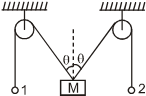
If points 1 and 2 both are acceleration with acceleration a downward, mass M will move with
Text Solution
Verified by ExpertsThe correct answer is:
C
Step 1: First, analyze the forces acting on the mass M. Since there are two tension forces due to the strings making an angle \( \theta \) with the vertical, we can denote the tension in each string as T.
Step 2: The vertical component of the tension forces helps in balancing the downward acceleration 'a' and the weight of the mass M. The vertical component of the tension can be expressed as \( T \cos \theta \). Therefore, for both sides, we can express the equation as:
\[ 2T \cos \theta = M(g - a) \]
where 'g' is the acceleration due to gravity.
Step 3: We need to express T in terms of acceleration 'a'. Rearranging gives:
\[ T = \frac{M(g - a)}{2 \cos \theta} \]
This indicates that to achieve the downward acceleration equal to 'a', the tension has to compensate for the change from gravity, which leads to a downward acceleration that modifies the effective gravitational pull on mass M.
Step 4: The mass M will accelerate at an effective acceleration downward given the tension and angle, simplifying down. We find that replacing this into our earlier derived expression leads us to:
\[ a_{effective} = a \cdot \sec \theta. \]
Therefore, the answer that corresponds to this effective acceleration is:
\( a_{effective} = a \sec \theta \), hence the correct option is: C.
Step 2: The vertical component of the tension forces helps in balancing the downward acceleration 'a' and the weight of the mass M. The vertical component of the tension can be expressed as \( T \cos \theta \). Therefore, for both sides, we can express the equation as:
\[ 2T \cos \theta = M(g - a) \]
where 'g' is the acceleration due to gravity.
Step 3: We need to express T in terms of acceleration 'a'. Rearranging gives:
\[ T = \frac{M(g - a)}{2 \cos \theta} \]
This indicates that to achieve the downward acceleration equal to 'a', the tension has to compensate for the change from gravity, which leads to a downward acceleration that modifies the effective gravitational pull on mass M.
Step 4: The mass M will accelerate at an effective acceleration downward given the tension and angle, simplifying down. We find that replacing this into our earlier derived expression leads us to:
\[ a_{effective} = a \cdot \sec \theta. \]
Therefore, the answer that corresponds to this effective acceleration is:
\( a_{effective} = a \sec \theta \), hence the correct option is: C.
Prepare Smarter with CGP Edu
Get practice questions, solutions, and test series in one place.
Write a Review
Share your experience with this question and solution.
Commentary
Send your comment, doubt, correction, or feedback to admin.
Similar Questions
Explore conceptually related problems
A block is dragged on smooth plane with the help of a rope which moves with velocity v. The horizon…
Two masses are connected by a string which passes over a pulley accelerating upward at a rate A as …
In the shown figure acceleration of mass M is
A rod AB is slipping on a frictionless surface as shown. It acceleration of A is 10 m/s 2 downward,…
The ratio of magnitudes of acceleration of A and B is
For the arrangement shown in figure, pulleys and strings are ideal Find out the acceleration of 2 k…